
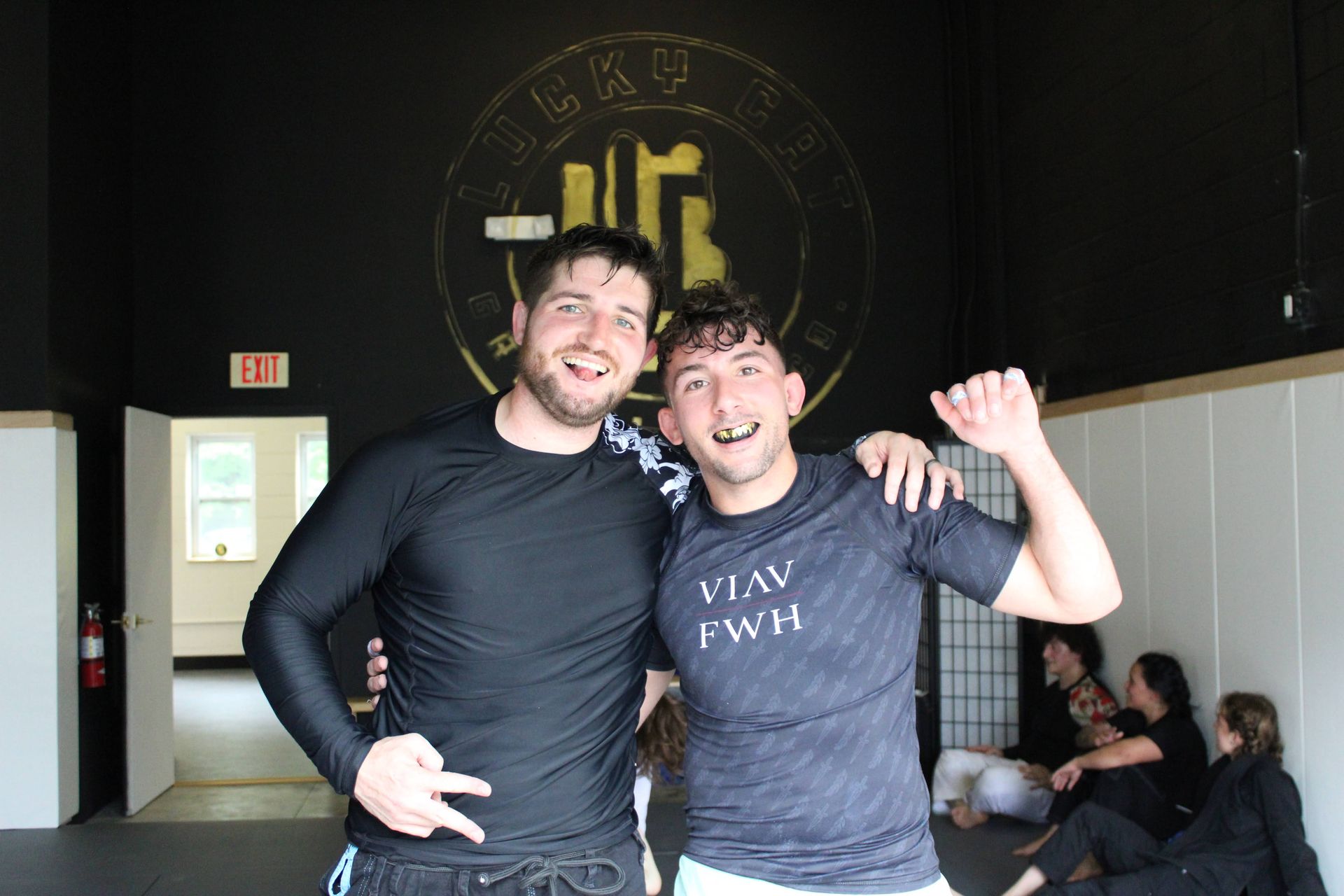
Jiu-Jitsu gives you a safe place to practice staying calm under pressure, so life outside the gym feels more manageable.
If you live in Manalapan, you already know how quickly a normal week can stack up: work stress, school pressure, family schedules, commuting, and the mental noise that comes with always being “on.” We built our Jiu-Jitsu program for real people living real lives, not just for athletes with endless free time.
What surprises most new students is how fast Brazilian Jiu-Jitsu becomes more than a workout. Yes, you’ll sweat and learn skill, but you’ll also train your mind to reset when things get uncomfortable. That’s where the mental toughness and balance come from, and it’s why so many people stick with it once they start.
In this guide, we’ll break down how training works, what you can expect in class, and why the lessons you learn on the mat translate so cleanly to your everyday life in Manalapan.
Why Jiu-Jitsu Builds Mental Toughness (Not Just Physical Toughness)
Mental toughness is not about being fearless or “hard.” In our experience, it’s the ability to stay present, make decisions, and keep trying when your body is tired and your plan is not working. Jiu-Jitsu creates that practice environment naturally because every round has problems to solve.
When you’re learning to escape a pin or keep your balance during a scramble, you’re forced to regulate your emotions in real time. If you panic, you gas out. If you get frustrated, you make sloppy choices. If you breathe, slow down, and focus on the next small step, you improve quickly. That pattern becomes a skill, not a personality trait.
Over time, students start noticing the shift outside the gym too. The same brain that learns to pause, breathe, and reframe a tough position can do the same thing in a stressful meeting, a tense family moment, or a day that simply didn’t go to plan.
Pressure is the teacher, and we keep it controlled
One reason Brazilian Jiu-Jitsu in Manalapan, NJ works so well for mental development is that training involves pressure, but it’s structured. We coach you through the basics, we match intensity appropriately, and we build up sparring in a way that helps you learn without feeling thrown into the deep end.
You get exposure to discomfort in small, manageable doses. That’s important. It’s hard to build resilience if your first experience is overwhelming. Our job is to help you progress in a way that feels challenging but still safe and constructive.
Balance: What It Means on the Mat and Why It Carries Into Daily Life
“Balance” in Jiu-Jitsu is literal at first. You learn how to distribute weight, keep a stable base, and move without tipping yourself into bad positions. Beginners often think balance is something you either have or you don’t. It’s not. It’s mechanics, timing, and awareness, and we can teach all three.
But the bigger form of balance shows up once you train consistently. You start to recognize how much energy you waste fighting the wrong battle. On the mat, if you resist everything with raw effort, you burn out. If you choose your moments and use technique, you last longer and think more clearly. That lesson lands in everyday life in a way that’s hard to describe until you feel it.
A lot of people come to us looking for Martial Arts in Manalapan, NJ because they want structure. What they find is a routine that steadies them. Training becomes a time block where your phone is away, your attention is here, and the goal is simple: learn, breathe, improve.
Mindfulness without the buzzwords
You don’t have to “be a mindful person” to benefit from the mental side of Jiu-Jitsu. The practice is built in. You can’t drift through a round while someone is trying to pass your guard. Your attention comes back to your breath, your posture, your grips, your next decision.
That constant return to the present is a form of mental training. And after a while, being present stops feeling like a special trick and starts feeling like something you can access anytime you need it.
What the Research Suggests About Jiu-Jitsu and Mental Strength
We like to keep the conversation grounded. While research on Brazilian Jiu-Jitsu is still growing compared with more mainstream fitness topics, the direction is encouraging.
A peer-reviewed study on Brazilian jiu-jitsu practitioners found that more experienced athletes tended to score higher in psychological qualities such as mental strength, resilience, grit, self-efficacy, self-control, and life satisfaction. The same line of research also suggests lower mental health disorders among more experienced belts compared with newer practitioners. In plain terms: staying with training seems to correlate with stronger mental tools.
Another scoping review focused on veterans and first responders reported that BJJ may help reduce symptoms associated with PTSD, depression, and anxiety, while also improving physical fitness and social integration. That social side matters. Humans do better with support, and a consistent training room can become a steady anchor in the week.
We never present Jiu-Jitsu as medical treatment, and we don’t make promises about mental health outcomes. What we can say confidently is that structured training, supportive community, and skill-based progress are a powerful combination for many people.
How Our Classes Build Resilience Through Progress, Not Ego
The quickest way to quit Jiu-Jitsu is to treat every round like a fight you have to win. Our approach is different. We focus on learning, safety, and steady improvement. That changes the emotional experience of training.
Resilience grows when you’re allowed to make mistakes and keep going. In class, you will get stuck. You will tap. You will forget steps. That’s normal. The win is showing up again and getting a little better at one thing: one escape, one grip, one moment of calm.
We also coach you to focus on process goals. Instead of “I need to submit someone,” we’ll guide you toward goals like “I’m going to maintain posture,” or “I’m going to recover guard,” or “I’m going to breathe through pressure for ten seconds longer than last time.” Those are measurable, realistic, and they build confidence that lasts.
What you learn, week by week
Here’s a clear snapshot of what most beginners develop as they train consistently:
• Calm decision-making under pressure, because you practice breathing and problem-solving in live rounds
• Confidence that comes from competence, since progress is skill-based and easy to track over time
• Better emotional control, because frustration and panic become signals to reset, not reasons to spiral
• Social accountability, because training partners notice when you show up and support you as you improve
• A stronger body and a steadier mind, because consistent movement and focused attention reinforce each other
That’s the heart of it: Jiu-Jitsu teaches you to keep your head when it would be easier to check out.
What a First Class in Manalapan Should Feel Like
If you’re nervous about starting, you’re not alone. Most people are. Walking into something new, especially Martial Arts in Manalapan, NJ, can feel intimidating if you’re picturing a room full of experts moving at a thousand miles per hour.
Our goal is for your first class to feel organized, welcoming, and clear. We’ll help you understand the flow of training, show you how to move safely, and give you a role even when everything feels brand new. You won’t be expected to know the language or the “right” way to do things immediately. That comes with time.
In a typical session, you’ll see a warm-up that prepares joints and muscles, technique instruction with coaching, and drilling that gives you repetitions without chaos. Depending on the class and your comfort level, you may also see controlled sparring, which is where the mental benefits really start to show up. We keep that environment respectful and structured.
What to bring and how to prepare
You don’t need fancy gear to begin. We’ll guide you on what’s appropriate for your first day. The most important thing is simply showing up ready to learn.
If you want an easy checklist, here it is:
1. Check the class schedule so you can arrive a little early and settle in
2. Bring water and a small towel, because you will work and you will sweat
3. Wear clean training clothes and keep nails trimmed for safety and comfort
4. Come with one goal: learn one thing and leave better than you arrived
5. Ask questions, because we would rather you feel informed than confused
When you’re new, clarity beats intensity. We’ll help you build the foundation first.
Do You Need to Be Athletic to Start Jiu-Jitsu?
No. You need to be willing to start. Jiu-Jitsu is one of the few martial arts where technique can level the playing field in a very real way, because leverage, timing, and position matter more than raw power.
If you feel out of shape, that’s actually a common reason people begin. Training gives you a plan and a community. It also gives you feedback that is immediate and honest. You’ll feel your cardio improve, your coordination sharpen, and your comfort under pressure grow.
We also scale intensity. There’s a big difference between training hard and training smart. Our coaching keeps you moving forward without feeling crushed.
How Often Should You Train to Feel the Mental Benefits?
Consistency beats intensity here. Most students notice mental changes with steady practice, not occasional bursts. In practical terms, training two to three times per week is a strong sweet spot for building momentum. It’s enough repetition to learn, but still realistic for busy schedules in Manalapan.
With once-a-week training, progress happens, but it can feel slower because you’re relearning the rhythm each time. With three days a week, patterns become familiar and confidence builds faster. That’s when Jiu-Jitsu starts showing up in your daily life: you handle stress better, you recover from setbacks quicker, and you feel more in control of your reactions.
If your schedule is unpredictable, we’ll help you build a routine that you can actually maintain. The best plan is the one you can follow.
Brazilian Jiu-Jitsu and Everyday Self-Control
A major mental benefit of Brazilian Jiu-Jitsu in Manalapan, NJ is learning self-control in close, physical situations. You learn when to push and when to relax. You learn that forcing everything usually makes it worse. You learn that patience can be a weapon, in the nicest possible way.
That skill is surprisingly rare in normal life. Most of us are trained to react instantly: reply fast, decide fast, fix fast. On the mat, rushing often creates mistakes. So you learn to slow down and see the next step. That carries over into conversations, decision-making, and even how you manage your own inner pressure.
Beginner-Friendly FAQ for Manalapan Residents
Is Jiu-Jitsu safe for adults who are nervous about injuries?
We prioritize safety through coaching, controlled intensity, and clear expectations around tapping and training responsibly. Like any contact sport, there is risk, but smart training dramatically reduces it.
What age is best to start?
We work with different ages and stages, and the best start time is usually “now” if your schedule supports it. Kids often thrive on the structure, and adults often love the stress relief and skill focus.
### Will I be embarrassed if I don’t know what I’m doing?
No. Everyone starts as a beginner. We expect questions, we teach fundamentals clearly, and we focus on progress instead of perfection.
Can Jiu-Jitsu help with focus and anxiety?
Many students report better focus and stress management because training demands presence and controlled breathing. We don’t treat or diagnose, but we do see training help people feel steadier.
What if I’m not competitive?
You do not need to compete to benefit. You can train purely for learning, fitness, confidence, and mental balance.
Take the Next Step
Building mental toughness is not a switch you flip. It’s a skill you train, and Jiu-Jitsu gives you a practical, honest way to train it while also improving strength, mobility, and confidence. If you want more balance in your week and a clearer head when life gets loud, the mat is a surprisingly good place to start.
That’s what we focus on every day at Lucky Cat Grappling Co. in Manalapan: structured training, supportive coaching, and a room where you can work hard, learn steadily, and leave feeling better than when you walked in.
No experience is needed to begin. Join a Jiu-Jitsu class at Lucky Cat Grappling Co. today.