
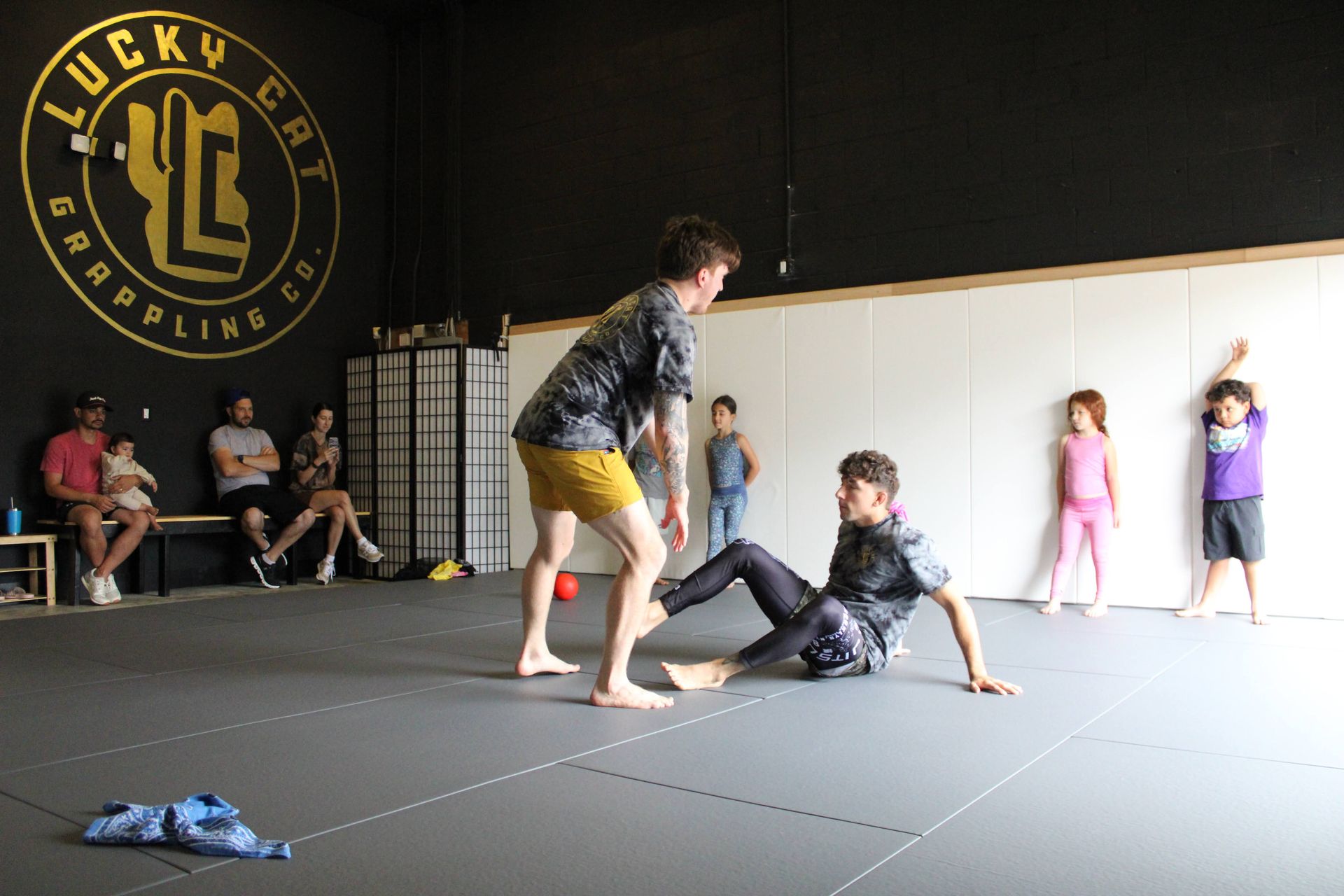
Jiu Jitsu turns stressful, messy situations into solvable puzzles you can practice safely, then apply everywhere else.
Jiu Jitsu is often described as physical training, but what keeps most people coming back is the thinking part. Every round asks you to make decisions with imperfect information, limited time, and real pressure, which is a lot closer to real life than most “problem solving” exercises. In our classes, you will feel that immediately: you try something, you get feedback, you adjust, and you try again.
Here in Manalapan, daily life can be busy in a very specific way. School schedules, commutes, family logistics, and work demands rarely arrive in neat order. Jiu Jitsu gives you a structured place to practice staying calm, prioritizing, and choosing the next best step, even when you are tired or stuck.
If you are looking at Brazilian Jiu Jitsu in Manalapan, NJ because you want more confidence, better fitness, or practical self-defense, we love that. But there is another payoff that surprises people: you start handling problems differently off the mat, too, because you have trained your brain to work through resistance instead of avoiding it.
Why Jiu Jitsu Feels Like “Human Chess” (and Why That Matters)
People call Jiu Jitsu “human chess” because it is strategic, layered, and constantly changing. But the bigger point is this: unlike a puzzle book, the puzzle pushes back. You are learning how to solve problems with an opponent who is actively trying to stop you, and you have to do it while managing your breathing, posture, and energy.
That combination creates a special kind of learning. When you drill a technique, you are building a clean blueprint. When you live roll, you stress-test that blueprint against chaos. Over time, you stop needing perfect conditions. You learn how to build a solution from whatever position you have, right now.
This is why Jiu Jitsu transfers so well to everyday situations. Work projects change midstream. A child melts down when you are already late. A plan does not survive contact with reality. On the mat, that is normal. You train for normal.
The Core Problem Solving Loop We Train Every Day
A lot of real-world problem solving fails because people skip steps. They panic, force an answer, or freeze. Jiu Jitsu gives you a repeatable loop that becomes instinct, and it is simple enough to remember under pressure:
1. Identify the problem: What is actually happening right now (position, grips, balance, space)?
2. Stabilize: Breathe, frame, base, protect yourself, and stop the worst outcome first.
3. Create options: Move toward an escape, sweep, or guard recovery that matches what you feel.
4. Test and adapt: If the first option fails, you learn quickly and pivot without drama.
5. Reset and improve: After the round, you troubleshoot, ask questions, and refine the plan.
That loop is not just “martial arts mindset.” It is a practical skill you can feel in your body. The mat makes it honest.
Problem Solving Under Stress: What Rolling Teaches That Books Can’t
Stress changes your decision-making. Your field of attention narrows, your breathing gets shallow, and suddenly the simplest tasks feel hard. Live training is valuable because it recreates that pressure in a controlled environment, with partners and coaches keeping it safe and constructive.
When you are pinned, for example, your brain wants to thrash and push. We teach you to slow down and do the opposite of panic: build frames, make space, and recover position one step at a time. That ability to “downshift” is a real skill, not a personality trait.
You also learn to accept immediate feedback without taking it personally. If a choice fails, the result is clear. That makes you more resilient in the real world because you become less attached to being right and more focused on what works.
Small Choices, Big Outcomes: How Strategy Shows Up in Jiu Jitsu
One of the best things about Jiu Jitsu is that tiny decisions matter. If your elbow is one inch out of place, a submission appears. If your hips turn at the right moment, an escape opens. This teaches you to pay attention to details, not in an obsessive way, but in a “details change outcomes” way.
We build strategy by teaching positions as connected systems. Instead of memorizing ten unrelated moves, you learn how one choice leads to the next. You start recognizing patterns: when someone shifts weight, when a grip is about to change, when your balance is vulnerable.
That pattern recognition is problem solving. In the real world, it looks like spotting issues earlier, making cleaner plans, and noticing the small signals you used to miss.
Creativity and Adaptation: You Learn to Build Solutions, Not Just Follow Scripts
A common misconception is that martial arts is mostly repetition. Drilling matters, yes, but the real magic is what happens when the situation does not match the drill. That is where you learn to create.
In Jiu Jitsu, you might start an escape and realize your partner blocked the path. Now you have to chain to a second idea, or change the angle, or switch to a different guard. That “chain thinking” is the same mental skill you use when a work plan runs into a constraint, or when you have to find a workaround with limited resources.
We encourage smart experimentation, especially for beginners who feel like there is “one right answer.” On the mat, there is often a best answer, but there are usually several workable answers. Learning that reduces anxiety, because you stop believing you must be perfect to succeed.
Patience, Timing, and Energy Management (Yes, That’s Problem Solving)
Most people start Jiu Jitsu using too much energy. It is normal. When you are unsure, you try harder. But effort without direction burns you out and creates openings. With coaching and repetition, you learn a better approach: conserve energy, build structure, and choose moments to move.
That is timing. It is also problem solving, because you are learning to wait until your solution is actually available instead of forcing it. You will hear us talk about weight distribution, posture, and leverage because those concepts let smaller movements produce bigger results.
Off the mat, this shows up as better pacing. You stop trying to solve everything at once. You prioritize, handle what matters first, and leave the rest for later without guilt.
What You Can Expect in Our Classes in Manalapan, NJ
People sometimes worry they need to be “in shape” before starting. We build conditioning through the work itself, and we scale training so you can progress safely. Our classes follow a structure that supports learning and real-world application.
Here is what a typical session often includes:
- Technical instruction where we break a position into clear steps and “why” explanations
- Partner drilling to build timing, coordination, and confidence with the movements
- Situational rounds where you start from a specific problem (like escaping side control)
- Live rolling that lets you pressure-test your decisions in real time
- Quick debriefs so you can connect what happened to what you will do next time
This is one reason Martial Arts in Manalapan, NJ can feel so different when the training is alive and interactive. You do not just learn moves, you learn how to think while moving.
Kids and Teens: Building Calm Thinking, Memory, and Resilience
For kids and teens, Brazilian Jiu Jitsu in Manalapan, NJ can be a surprisingly practical form of cognitive training. The techniques are physical, but the lessons are mental: listen, remember, try, fail safely, and try again. That cycle builds patience and confidence without needing a lecture.
In youth classes, we focus on clear structure and positive coaching. Kids learn to work with partners, follow boundaries, and handle frustration when something does not click right away. They also learn that mistakes are part of the process, not a reason to quit.
Over time, you may notice improvements outside the gym. Many parents tell us their kids get better at sticking with hard tasks, staying composed when challenged, and communicating more respectfully during conflicts. Those are real-world problem solving skills, just practiced through movement.
How Fast You’ll Notice Benefits (and What Consistency Looks Like)
Some benefits show up quickly. Within the first 4 to 8 weeks, many new students feel more confident simply because they have practiced discomfort in a safe place. You learn you can be tired and still think. You can be stuck and still find a path out.
Deeper changes typically build over 3 to 6 months when you train consistently, often 2 to 3 sessions per week. That is when pattern recognition improves, your reactions get calmer, and you begin anticipating instead of only responding.
Consistency matters more than intensity. One steady week after another beats occasional “all out” bursts. We would rather see you train at a sustainable pace that fits your life in Manalapan than push too hard and disappear for a month.
Turning Mat Skills Into Everyday Wins
The most useful part of Jiu Jitsu is that it changes how you approach friction. You get used to solving problems in layers: survive, stabilize, improve position, then attack. That sequence applies to plenty of real situations.
A few examples of mat-to-life translation we see often:
- You pause and breathe before responding to stress, because you have practiced breathing under pressure
- You break big tasks into smaller steps, the same way you build an escape in pieces
- You get comfortable asking for feedback, because coaching is part of the culture
- You recover faster after a setback, because every round is a reset opportunity
- You make decisions with the information you have, then adjust, instead of waiting for perfect certainty
That is not motivational fluff. It is the direct result of training your nervous system to stay engaged when things get difficult.
Ready to Begin
Building real problem solving skills takes more than theory, and that is exactly what we train every day. At Lucky Cat Grappling Co., we use Jiu Jitsu as a practical framework for staying calm, making smart decisions under pressure, and adapting when plans change, because that is what real life demands.
If you are curious about Brazilian Jiu Jitsu in Manalapan, NJ for yourself or your child, we will meet you where you are and help you progress with clear coaching and a supportive room. The fastest way to understand the benefits is to experience a class and feel how quickly your mindset starts to shift.
Become part of a welcoming and disciplined training community by joining a Jiu-Jitsu class at Lucky Cat Grappling Co.