
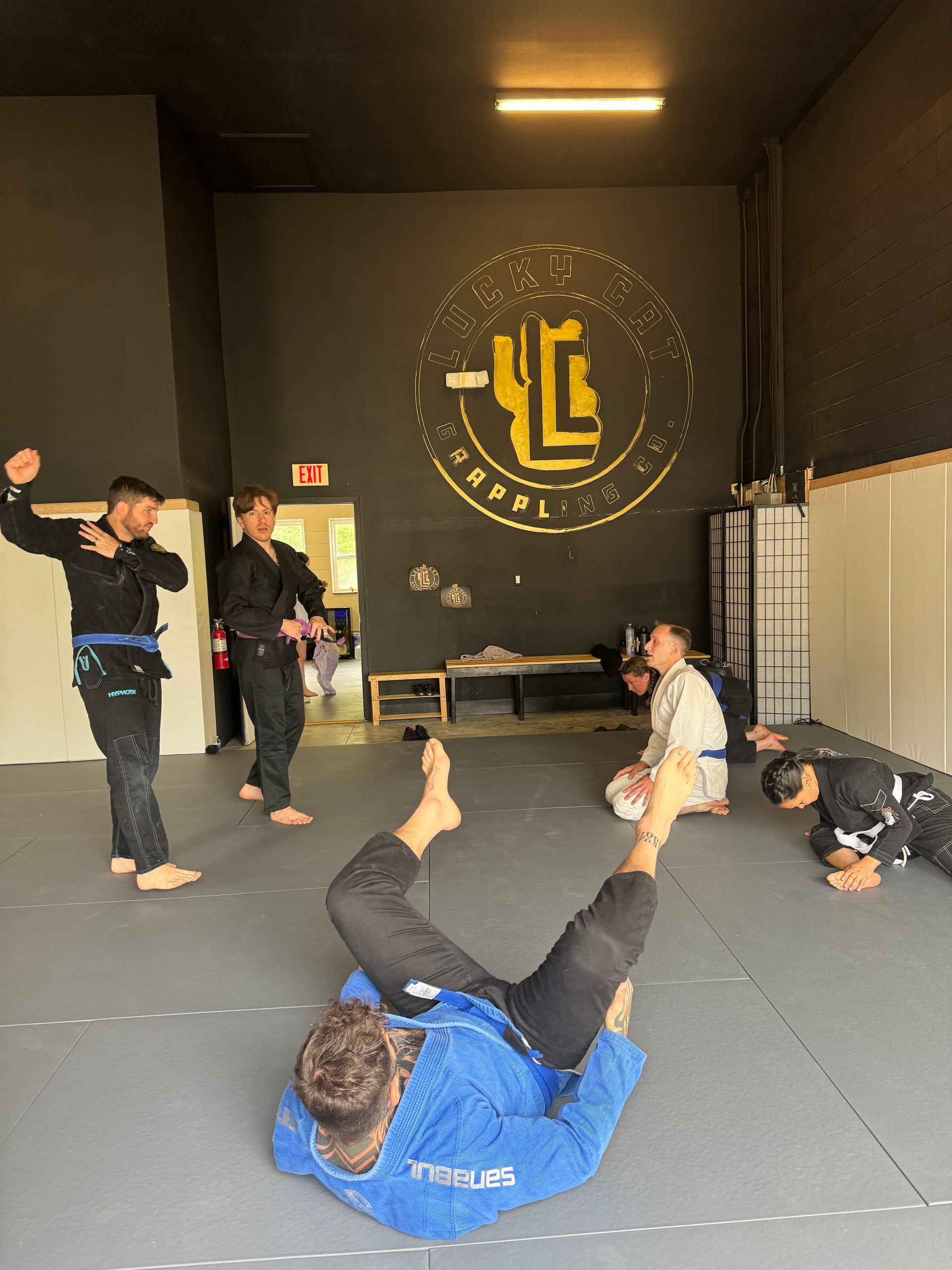
Jiu-Jitsu gives you a workout for your body and a reset button for your mind, all in one class.
If you live in Manalapan and you want training that does more than just “get you tired,” Jiu-Jitsu is one of the most practical places to start. In a single week of consistent classes, most people notice it: you’re thinking more clearly, moving better, and handling pressure with a little more control than you did before.
We teach Jiu-Jitsu as a skill you build, not a talent you either have or you don’t. You don’t need to be “in shape first,” and you don’t need a background in sports. You just need a willingness to learn and show up, and we’ll coach the rest with a fundamentals-first approach that keeps progress steady and training safe.
In this guide, we’ll break down exactly how Jiu-Jitsu in Manalapan builds focus, strength, and real-world skills and how that carries over into work, school, and everyday confidence.
Why Jiu-Jitsu builds focus faster than most activities
Focus is not just willpower. In real life, focus is the ability to stay present when things get chaotic: a deadline, a crowded schedule, a tough conversation, a kid melting down in the back seat, you name it. On the mats, that chaos becomes a training tool, and we use it intentionally.
The “problem-solving loop” trains attention
Jiu-Jitsu is constant decision-making. Where are your hands? Where is your weight? What is your partner trying to do next? You’re reading cues and making adjustments in real time. It’s not memorizing a routine and hoping it works. It’s learning to observe, choose, and act.
Over time, you get better at:
- Noticing small details (posture, grip, balance)
- Staying calm when you’re uncomfortable
- Resetting quickly after a mistake instead of spiraling
That’s focus. And it’s a lot more transferable than people expect.
Repetition creates mental quiet
In our classes, we drill fundamentals and core movements often. At first, repetition feels like “work.” After a while, repetition becomes grounding. Your brain stops chasing ten different thoughts at once and starts doing one thing well.
Many students tell us Jiu-Jitsu becomes the part of their week where their mind finally settles down. Not because training is easy, but because it’s clear. You have one job: solve the next moment.
Pressure management is a skill, not a personality trait
A big reason focus improves through Jiu-Jitsu is that you practice staying present under pressure in a controlled environment. You learn how to breathe, how to frame, how to create space, and how to think when you’d rather panic.
That’s exactly what “real focus” looks like. It’s not perfect calm. It’s choosing useful actions while your heart rate is up.
The strength you build is functional, not just aesthetic
Yes, Jiu-Jitsu is a full-body workout. But what makes it different is the kind of strength you develop. We’re not chasing one-rep maxes in a mirror. We’re building usable strength: the ability to control your body and manage another person’s movement safely.
You develop full-body coordination
Jiu-Jitsu makes your whole body work together. Your hips, core, back, and legs connect through movements like bridging, shrimping, standing up in base, and maintaining posture under resistance. Those basics are simple, but they’re not “easy,” especially when timing matters.
As you train, you’ll notice improvements in:
- Core stability and hip strength
- Grip endurance and pulling strength
- Balance, posture, and body awareness
- Cardiovascular conditioning from live rounds
And the best part is that the strength builds as a byproduct of learning skill. You’re not just working hard. You’re working toward something.
Conditioning happens naturally through rounds and pacing
People sometimes ask if they need to “get in shape” before starting Adult Jiu-Jitsu in Manalapan, NJ. Our answer is straightforward: training is how you get in shape. We pace classes in a way that supports beginners while still challenging experienced students, and we coach you on how to manage your effort.
The goal isn’t to redline every minute. The goal is sustainable progress. You’ll work hard, you’ll sweat, and you’ll also learn how to conserve energy, breathe, and stay efficient.
Strength includes injury-prevention habits
We take movement quality seriously. When you learn to base, frame, and move your hips correctly, you’re not only improving performance, you’re also protecting your body. We reinforce tapping early, training with control, and building good positions before chasing fast submissions.
In other words: strong is good, but durable is better.
Real-world skills: what Jiu-Jitsu actually teaches you to do
“Real-world” doesn’t mean walking around looking for problems. Real-world skills mean having options and confidence if something goes wrong. Jiu-Jitsu is built around leverage, control, and escapes, which is why it’s often chosen by people who want practical self-defense without relying on being bigger or stronger.
You learn how to control distance and position
A lot of safety comes down to position. In Jiu-Jitsu, position decides who has options. We teach you how to:
- Stay balanced when someone tries to move you
- Get back to your feet safely
- Control an opponent’s hips and shoulders
- Escape from bad positions methodically instead of guessing
This is not theory. You practice it with resistance, and that’s what makes it stick.
You practice decision-making when things are messy
Real situations are unpredictable. Training gives you experience dealing with unpredictability, but in a supervised environment with rules, structure, and coaching. When you roll live, your partner is trying to win, but the goal is mutual development and safety.
That practice builds a kind of quiet confidence. Not loud. Not aggressive. Just calm capability.
Awareness and boundaries improve too
Something people don’t talk about enough is how training changes your posture and presence. You start standing differently. You make clearer decisions. You feel more comfortable setting boundaries because you’re less “in your head” about what could happen.
That’s a real-world benefit, and you don’t need to compete to earn it.
Why Jiu-Jitsu works for busy adults in Manalapan
Adult life can feel like a pile of tabs open in your brain. Work, family, errands, schedules, and then the pressure to “also take care of yourself.” Jiu-Jitsu helps because it’s structured, challenging, and mentally absorbing.
Stress relief that isn’t just zoning out
Some activities help you escape. Jiu-Jitsu helps you engage. You can’t half-participate. You have to be present, and that’s why it’s so effective at breaking stress loops. Your attention gets pulled into the moment, and afterward you feel reset.
A community you can actually show up to
Consistency is easier when the environment is welcoming and the coaching is clear. We work hard to keep the room supportive, beginner-friendly, and ego-light. You’re here to learn, and we’re here to help you do it.
Adult Jiu-Jitsu in Manalapan, NJ: a realistic starting point
If you’re new, our adult program emphasizes fundamentals, safety, and progressive training. You’ll learn the building blocks that make everything else easier later: posture, base, escapes, guard concepts, and basic submissions taught with context.
You don’t need to “know what you’re doing” before you walk in. That’s literally why class exists.
Why parents choose Youth Jiu-Jitsu in Manalapan, NJ
Kids today have plenty of stimulation, but not always enough structured challenge. Youth Jiu-Jitsu in Manalapan, NJ gives kids a place to practice focus, body control, and respectful behavior in a setting that feels fun and meaningful.
Focus and listening skills, taught through movement
We keep kids engaged by giving them clear goals and simple steps: line up, learn the movement, practice it, and then apply it in controlled partner drills. That structure teaches attention in a way that feels natural, not forced.
Confidence built the right way
Confidence is not just hype. Real confidence comes from doing difficult things and improving over time. When kids learn how to escape a pin, maintain balance, or problem-solve under pressure, they earn confidence that carries into school and social situations.
Social development and self-control
Jiu-Jitsu is close-contact training, so respect and boundaries matter. Kids learn to cooperate, take turns, handle winning and losing appropriately, and stay composed. Those are life skills, and they’re valuable far beyond the mats.
What to expect in your first class
Starting something new can feel like a lot, especially if you’re not sure what the room will be like. We keep first classes straightforward, welcoming, and guided.
Here’s what your first visit typically looks like:
1. You arrive a bit early so we can get you oriented, answer questions, and go over basic safety rules.
2. We start with a warm-up that introduces key movements you’ll use often, without trying to crush you on day one.
3. You learn a small set of fundamental techniques with clear steps, then you drill them with a partner at a controlled pace.
4. Depending on the class and your comfort level, you may try light positional sparring, where you practice a specific scenario rather than “anything goes.”
5. We wrap up with guidance on what to focus on next, plus how to use the class schedule to stay consistent.
What to wear and bring is simple: comfortable training gear, water, and a willingness to learn. If you have questions before you arrive, the website is the easiest place to check program details and timing.
How often should you train to see results?
Results come from consistency, not intensity spikes. For beginners, we usually recommend starting with two to three classes per week if your schedule allows. That’s enough frequency to retain what you learn, build conditioning, and feel momentum without burning out.
If you can only make it once a week, you can still improve, it just takes a little more patience. The key is showing up regularly and letting the fundamentals stack.
Common questions we hear in Manalapan
Is Jiu-Jitsu good for beginners?
Yes. We teach beginners every week, and our coaching is designed to make the learning curve manageable. Everyone starts somewhere, and we make sure you have a clear path.
Is Jiu-Jitsu safe for kids?
Any contact sport has risk, but we reduce it through supervision, rules, controlled drilling, and age-appropriate training. We emphasize tapping, control, and respect from day one.
Do I need to be strong or athletic?
No. You’ll build strength and athleticism through training. Jiu-Jitsu is especially effective because technique and leverage matter, which gives you a way to progress even before you feel “fit.”
What’s the difference between Jiu-Jitsu and other martial arts?
Our focus is on grappling: control, escapes, positioning, and submissions. That makes it a practical option for self-defense and a demanding full-body workout, without relying on striking.
What should I expect in my first month?
Expect to learn foundations, feel a lot of new muscles wake up, and have moments where things click. Progress in Jiu-Jitsu is real, but it’s layered. We’ll guide you step by step.
Take the Next Step
Building focus, strength, and real-world readiness is not about becoming a different person overnight. It’s about practicing useful skills consistently in an environment that keeps you challenged and supported. That’s what we aim to deliver every time you step on the mats.
If you’re ready to start Jiu-Jitsu in Manalapan with a clear plan, supportive coaching, and training that prioritizes personal growth, we’d love to help you take that first class at Lucky Cat Grappling Co. and see what the process feels like in real time.
Ready to train? Join a Jiu-Jitsu class at Lucky Cat Grappling Co. today.