
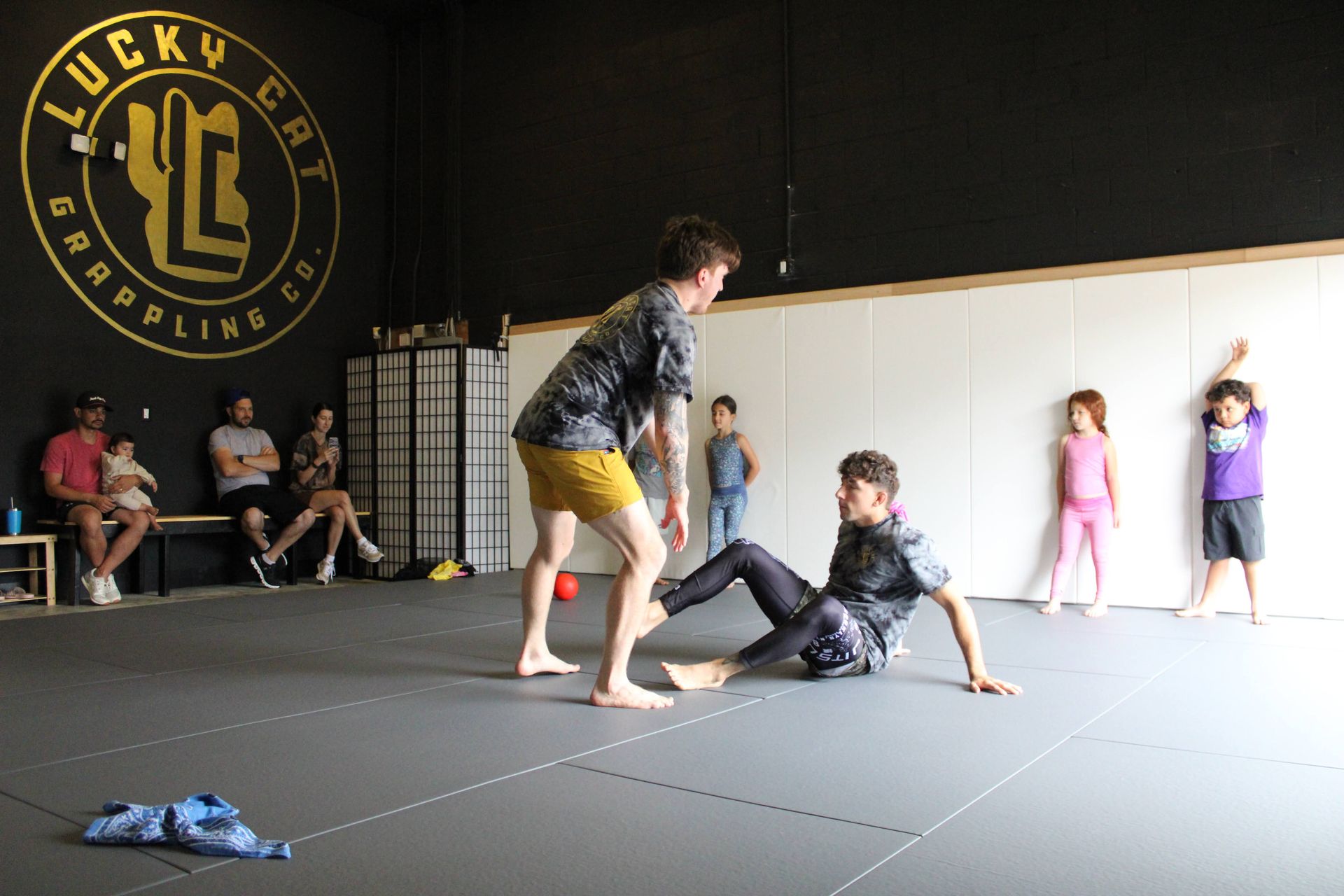
Dynamic mobility is what turns techniques you know into movement you can actually use, on the mat and in real life.
Jiu Jitsu keeps growing for a reason: it rewards people who learn to move well, not just people who muscle through positions. Across the U.S., roughly 750,000 people train, and worldwide participation is estimated around 6 million, with search interest more than doubling since 2004. We see that same momentum locally in Manalapan, where students want training that improves fitness, confidence, and problem-solving without needing to be a lifelong athlete first.
Our focus in class is simple to say and harder to master: move with purpose. Dynamic mobility in Jiu Jitsu means you can create angles, recover guard, stand up safely, and transition smoothly from defense to offense. It is not about being “fast” in a frantic way. It is about being efficient, balanced, and hard to pin down.
If you are looking for Brazilian Jiu Jitsu in Manalapan, NJ, the most valuable skill you can build early is the ability to connect your feet, hips, and hands into one coordinated system. That is what this guide will help you understand, and what we train every week on the mats.
Why dynamic mobility matters in modern Jiu Jitsu
Competitive trends tell a clear story: grappling is getting more movement-heavy, not less. At major events in 2024, wrestling-style takedowns showed up at record levels, and finishing sequences leaned heavily toward high-percentage fundamentals, especially chokes. That combination says something important for your training in Manalapan: if you cannot move into and out of contact cleanly, your techniques stay “theoretical.”
Mobility is also one of the best ways to make your Jiu Jitsu feel safer. Injury surveys in grappling regularly show high rates, with roughly 59 percent of athletes reporting an injury in a six-month window in a well-cited study that continues to be echoed in newer surveys. We cannot eliminate risk entirely, but we can coach you toward movement habits that reduce awkward torque, bad posting, and panicked bridging.
Finally, dynamic mobility makes training more fun. When you start linking movements together, your rounds stop feeling like you are stuck in a puzzle with missing pieces. You begin to see transitions before they happen, which is a nice moment when it clicks.
Build your mobility base: posture, frames, and hip connection
Posture is your steering wheel
Posture is not just “sit up straight.” In Jiu Jitsu, posture is your ability to keep alignment while someone pulls, pushes, or twists you. When your posture collapses, your hips usually follow, and then your guard passing or your stand-up starts to feel slippery in a bad way.
We teach posture as a set of repeatable checkpoints: head position, spine shape, and where your weight is distributed through knees or feet. You do not need to memorize a textbook. You just need a few reliable cues you can return to mid-round.
Frames create time to move
Frames are your temporary structure: forearms, shins, hands, and elbows placed to keep distance and protect your neck and hips. People often think mobility means constant motion, but smart mobility includes “stopping points” where you are safe enough to choose your next move.
A clean frame lets you hip-escape with less effort, re-guard more often, and stand up without leaving your neck exposed. The goal is not to stiff-arm. The goal is to create just enough space to move your hips.
Hips connect everything
Most “stuck” feelings in Brazilian Jiu Jitsu come from hips that are late to the party. Your hips are the engine for escapes, guard retention, and many submissions. When you learn to move your hips first, your upper body stops working overtime, and your breathing gets calmer, too.
We drill hip connection with controlled repetitions: hip escapes, technical stand-ups, and simple guard recovery patterns that scale from beginner to advanced without changing the core idea.
Mobility-forward guard work: retention, recovery, and stand-ups
Guard is not a static position you hold forever. It is a movement system. A mobile guard lets you retain, recompose, or come up to a safer position even when passing pressure is real.
Guard retention that does not rely on flexibility
You do not need gymnast flexibility to retain guard. You need timing and angles. We teach you to track your partner’s shoulders and hips, to pummel your legs back inside, and to rotate on your side rather than staying flat. Staying flat is the fastest way to feel heavy pressure.
A practical detail we emphasize is “inside space.” If your knees and feet can consistently win inside position, your mobility options multiply. If your legs drift outside, your guard becomes a guessing game.
Recovery to guard, then immediately make a decision
A common stall is recovering guard and then freezing. Mobility-based Jiu Jitsu means you recover and then choose: off-balance, attack, or stand. Even if you are tired, having a decision makes your movement more efficient because you stop doing random things.
We like to structure rounds where your goal is not to submit. Your goal is to recover guard cleanly and transition to one follow-up. That kind of constraint training makes you sharper fast.
Technical stand-up is a self-defense and sport skill
Standing up safely is one of the most useful skills in martial arts in Manalapan, NJ because it translates beyond the mat. In training, it also changes your whole game. When you can technical stand-up confidently, you become harder to hold down, and you can connect guard work to takedowns and top pressure.
We coach the stand-up with attention to distance management and protecting your head and posture. It is not flashy. It is just effective.
Takedowns and wrestling integration for Manalapan training
The sport is moving toward more wrestling influence, and the data reflects it. In 2024 high-level events, takedown activity reached notable highs, which means your mobility cannot be only “ground mobility.” You also need entry mobility: level changes, footwork, and balance during contact.
What we prioritize for safe, effective takedown mobility
We teach takedowns as part of a whole chain: stance, movement, entry, finish, and then controlling the landing into a top position. The goal is not to hit a perfect highlight-reel shot. The goal is to develop confident movement under pressure.
Here is what we focus on most often in class:
• Stance and motion you can maintain while breathing steadily and protecting your balance
• Hand fighting basics that create openings without overreaching or exposing your back
• Level changes that keep your spine safe and your hips underneath you
• Finishes that transition directly into control, not a scramble you cannot manage
• Mat returns and top pressure concepts that reduce chaos and keep training partners safe
If you are new, we scale intensity. If you are experienced, we add layers. Either way, your movement quality comes first.
Passing with movement: pressure plus angles, not just force
People sometimes hear “dynamic mobility” and assume we avoid pressure. We do not. Pressure is part of Jiu Jitsu. But we teach pressure as something you arrive at through angles and connection, not something you brute-force with your arms.
Mobility-based guard passing habits
Good passing is a cycle: unbalance, clear frames, win inside space, and settle. When you skip steps, you tend to get stuck in half guard battles that feel like pushing a car uphill.
We coach passing patterns that keep your hips active and your head in the right spot. Small changes, like switching your base or changing your hip angle, often matter more than “driving harder.” You will still work, sure, but the work has a direction.
Why chokes dominate, and what that means for your movement
At major 2024 events, about 65 of submission finishes were chokes, with arm attacks around 20. That should influence how you train mobility: your neck and posture awareness have to stay sharp during scrambles, takedown exchanges, and passing sequences. If your head drifts or your posture breaks, chokes appear fast.
We build choke awareness into movement drills, not just submission-of-the-day. You learn to keep your chin position smart, clear grips, and move your shoulders and hips together so your neck does not become the lever.
Gi vs no-gi: which builds better mobility?
We teach mobility principles that transfer across both, but each format pressures your movement differently. Gi training often slows exchanges just enough to make details obvious. No-gi can force faster reactions because grips are less sticky and scrambles happen sooner.
A useful reality check from recent elite results: all ADCC 2024 champions had gi backgrounds, which reinforces the value of building strong fundamentals even if your goals are no-gi. We use that idea in a practical way: fundamentals first, then speed.
If you are deciding where to start, we typically recommend starting in the gi to build posture, grip fighting, and layered escapes. Then, when you step into no-gi, your mobility has structure instead of improvisation.
How we structure training for dynamic mobility and steady progress
A big part of improving mobility is repetition with just enough resistance to be realistic. Too little resistance and you are shadowboxing. Too much resistance and you are surviving without learning.
We use a progression that keeps you learning while protecting your body:
1. Technical reps to learn the shape of a movement and where your frames belong
2. Positional rounds where you start in a specific spot, like bottom side control or a guard retention scenario
3. Constraint sparring with one goal, like stand up safely or recover guard and off-balance once
4. Open rolling where you test what is sticking and what needs more reps
5. Simple feedback loops so you leave knowing what to drill next time
If your schedule is busy, consistency beats volume. For many adults, two to three classes per week is the sweet spot where you improve without feeling beat up. More can work, but only if recovery, sleep, and intensity are managed like real training variables.
Injury prevention habits that support mobility
We take safety seriously because staying on the mat is what creates results. Mobility is protective when it is trained with control, good positions, and realistic pacing.
A few habits we reinforce every week:
• Warm up with movement patterns you will actually use, not random fatigue drills
• Tap early in training, especially when your posture is compromised or your limb is trapped
• Avoid posting on a straight arm during sweeps and scrambles, and learn to shoulder-roll instead
• Increase intensity gradually when adding takedowns, new submissions, or competition prep
• Communicate with training partners, because mutual control is part of good Jiu Jitsu
If you have old injuries, we can usually modify positions and goals while you rebuild strength and confidence. You still get meaningful work, just with smarter constraints.
Training in Manalapan: building skill that fits your life
Manalapan has a strong fitness culture, and access to New Jersey’s broader grappling scene makes it easier to stay motivated, whether your goal is competition or simply becoming harder to hold down. Our job is to make your training feel clear and repeatable, not confusing.
Dynamic mobility also fits a wide range of students. Some people want better athletic movement. Some want practical self-defense skills. Some want a hobby that challenges the mind. Jiu Jitsu can do all of that, and mobility is the common thread.
When you train consistently, you start noticing changes outside the gym: better balance, better posture, calmer breathing under stress, and a kind of quiet confidence that comes from solving hard problems repeatedly. It is not magic. It is reps, guidance, and a room where learning is normal.
Take the Next Step
If you want Jiu Jitsu that builds real dynamic mobility, our coaching, drilling structure, and class pacing are designed to help you move better without feeling lost in the process. At Lucky Cat Grappling Co., we keep the focus on fundamentals that show up under pressure: stand-ups, guard recovery, takedown entries, and the kind of control that makes your game feel reliable.
Whether you are brand new to martial arts in Manalapan, NJ or returning after time away, we will meet you where you are and help you build a plan you can actually follow. Check the website, look at the class schedule, and come in ready to learn one movement at a time, then connect them.
Put these techniques into practice by joining a Jiu-Jitsu class at Lucky Cat Grappling Co.