
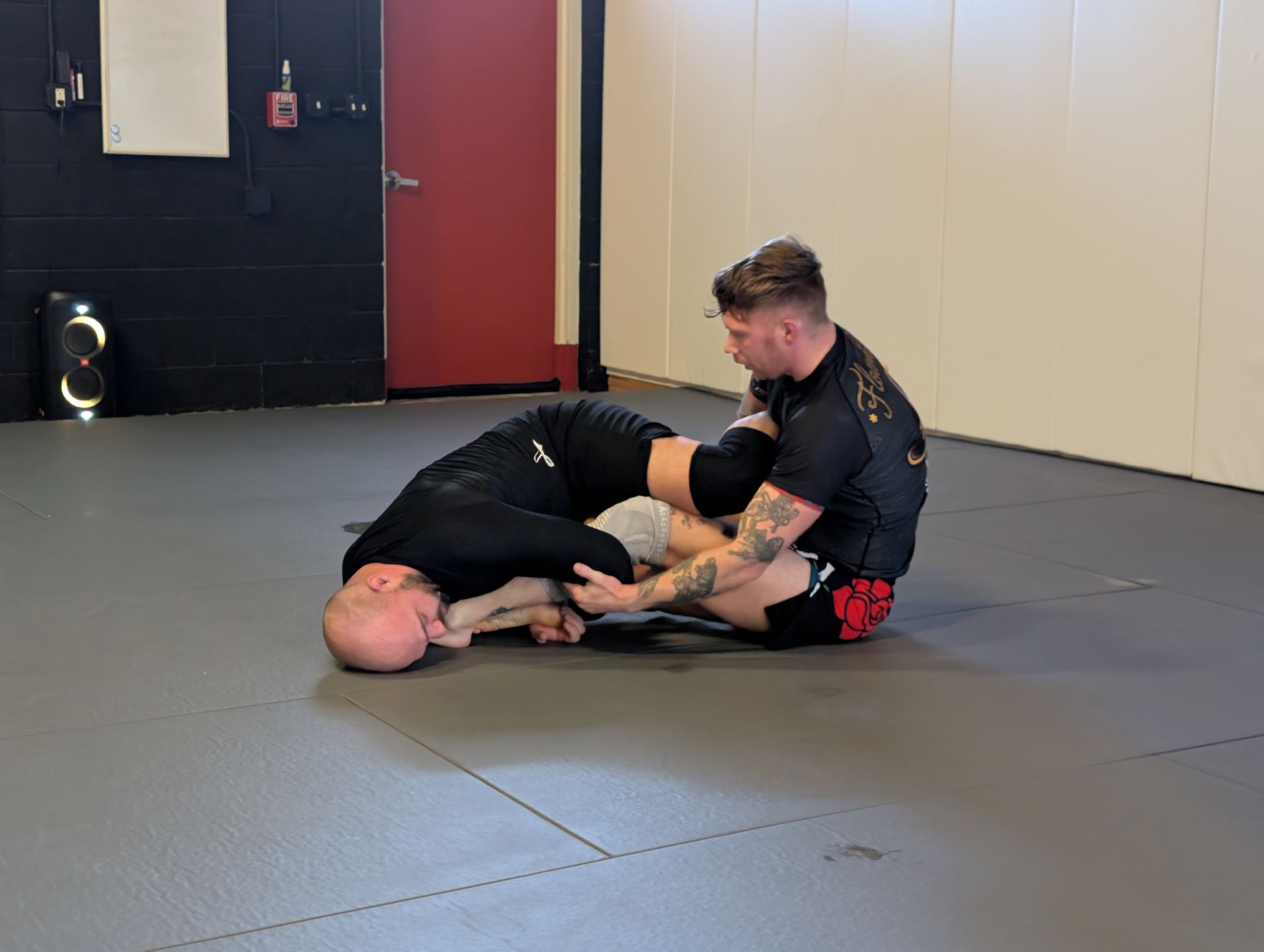
Jiu Jitsu gives you a place to practice staying calm under pressure, then brings that calm back into real life.
Stress in a suburban town can look pretty ordinary from the outside: traffic, deadlines, family schedules, nonstop notifications, and the feeling that your brain never fully powers down. The catch is that “ordinary” stress still has a real cost, and it tends to show up in sleep, patience, focus, and even how your body feels by the end of the week.
We like Jiu Jitsu because it takes that restless energy and gives it a clear direction. You learn to breathe when your heart rate spikes, solve problems when you would rather panic, and reset your mind in a room where you cannot multitask. It is training, but it is also practice for the messy parts of everyday life.
In Manalapan, NJ, many of us juggle commutes, demanding jobs, and family responsibilities, and we see firsthand how consistent training can turn stress into something useful: resilience, confidence, and steadier decision-making. That is what this article is about, and what our programs are designed to build.
Why stress feels louder in modern life
Stress is not always a dramatic crisis. Often it is a drip: a packed calendar, a tense email, a long ride on Route 9, another obligation that eats the last free hour of the day. Your nervous system does not really care whether the pressure comes from danger or from a calendar reminder. Over time, the body stays “on,” and the mind starts to expect friction everywhere.
When stress becomes your baseline, small problems feel huge. You get reactive. You stop sleeping deeply. You lose the sense that you have options, which is one of the fastest paths to feeling stuck. We train a different pattern: stay present, keep working, and use technique instead of tension.
For a lot of students, that shift is the first win. Not a perfect triangle choke, not a shiny new belt. Just noticing: “I’m handling things better.”
How Jiu Jitsu rewires stress into usable strength
Jiu Jitsu is a problem-solving art that happens to be physical. You are constantly answering questions in real time: Where is the pressure coming from? What is the safest next step? What can I do right now, with the position I have, not the one I wish I had?
That matters for stress because the training environment is controlled, but still intense. Your body wants to react quickly. Your mind wants to scramble. We teach you to slow down inside the storm. Over time, that becomes a skill you can access outside the gym.
Recent research trends between 2021 and 2025 have highlighted Brazilian Jiu Jitsu as a promising support for mental health, including sustained reductions in PTSD symptoms, anxiety, and depression, driven by exposure-like training, social support, and consistent practice. We are careful with big claims, but the direction is clear: practice helps.
The “pressure practice” effect: calm, even when it is uncomfortable
Most people are not short on motivation. We are short on calm. Jiu Jitsu gives you reps at staying calm when you are physically and mentally uncomfortable, and it does that in a surprisingly honest way.
When you are pinned, you cannot talk your way out. You have to breathe, make space, and work step by step. That skill translates to meetings, family conflict, and high-pressure moments at work because you learn to recognize the early signs of stress and interrupt the spiral.
We also see something else happen: students start separating sensation from story. The body feels stressed, but the mind does not have to turn it into “I can’t handle this.” That is a powerful shift.
Mental health benefits supported by real-world data
A growing body of evidence links Brazilian Jiu Jitsu training with reductions in PTSD symptoms, depression, anxiety, aggression, and hostility, while building resilience, self-control, confidence, empathy, and life satisfaction. Experience matters, too. Studies comparing belt levels show that more advanced practitioners report significantly higher mental strength, resilience, self-efficacy, and self-control, with fewer mental health disorders than beginners, and the gains tend to correlate with time on the mats.
We like that because it matches what we observe in class. Early training brings quick wins like better focus and mood. Longer-term training builds steadier traits: grit, emotional regulation, and the ability to recover from a bad day without falling apart.
One 2024 report found that many practitioners experienced improved focus, better stress management, and improved sleep quality. You do not have to be a competitive athlete to benefit. You just have to show up consistently and let the process work.
Why Brazilian Jiu Jitsu fits busy lives in Manalapan, NJ
Time matters. Energy matters. If training feels like another chore, it will not last. Our approach is to make training sustainable for real people in a real town, including commuters, parents, and professionals with unpredictable schedules.
Brazilian Jiu Jitsu in Manalapan, NJ makes sense because it is efficient training. You do not need hours of machines or complicated routines. You need a class, a coach, and partners who help you improve safely. You get strength, conditioning, coordination, and stress relief in one place.
Also, there is the community factor. Suburban life can be oddly isolating even when you are busy. Training gives you regular human connection that is not a meeting and not another screen.
What stress looks like on the mats, and why that is a good thing
At first, the stress can feel physical: heavy breathing, tight shoulders, the urge to “muscle through.” That is normal. Most beginners start by using effort as a strategy. Then technique shows up and changes the rules.
We coach you to find small wins: posture, frames, hip movement, and escapes that conserve energy. Those skills build confidence fast because you can feel the difference immediately. You realize you do not have to be the strongest person in the room to be effective.
That is when training stops being a grind and starts being a craft.
A simple progression: from survival mode to problem-solver
Progress in Jiu Jitsu is not just learning moves. It is changing how you respond to pressure. Beginners often feel like everything is happening at once. With time, the game slows down.
Here is the progression we see most often:
1. You learn to survive safely, breathe, and tap early when needed
2. You learn basic positions and escapes that stop panic from taking over
3. You start chaining decisions together, not just reacting
4. You develop timing and control, which creates real confidence
5. You apply the same calm problem-solving to work, relationships, and daily stress
That is why experience matters so much in the research. The longer you train, the more your default response shifts from “brace” to “solve.”
Leadership and decision-making under pressure
Leadership is not only for managers and supervisors. It is for parents, partners, team members, and anyone who wants to respond well when things get hard. Jiu Jitsu builds leadership traits in a practical way: emotional stability, stress management, decision-making under pressure, and social awareness.
We see this especially with people in high-stakes roles, including first responders and veterans. The training environment creates controlled exposure to pressure, plus the support of a team. That combination is a big deal. You practice discomfort, then you practice recovery.
And on a normal Tuesday night, that can look very simple: you get caught, you tap, you reset, you try again. That loop teaches humility and confidence at the same time, which is a rare pairing.
Physical stress relief that supports mental strength
The mind and body are linked whether we like it or not. When your body is sedentary, stiff, and underslept, stress hits harder. Jiu Jitsu helps on the physical side in ways that support mental resilience.
Training can improve cardiovascular health, mobility, flexibility, and overall conditioning, and it often improves sleep quality. You also get the immediate benefits of movement: endorphins, a clearer head, and a sense that you did something real with your day.
In a town where many people spend hours sitting in cars or at desks, this matters. It is not just fitness for fitness’s sake. It is stress hygiene.
What you actually learn in our classes (and why it calms your nervous system)
We keep training practical and structured so you know what you are building each week. While every class has its own focus, the core skills are consistent, and they are designed to reduce the chaos beginners often feel.
In our program, you can expect to work on:
• Positional fundamentals like guard, side control, mount, and back control, so you understand the map before you sprint
• Escapes and defensive posture, because feeling safer reduces panic and improves learning speed
• Submissions as controlled technique, not aggression, which builds precision and self-control
• Live training at an appropriate intensity, so you practice decisions under pressure without reckless intensity
• Training etiquette and partner awareness, so the room feels supportive and focused, not tense
This is also why martial arts in Manalapan, NJ can be more than a workout. The structure teaches your nervous system to settle, even while your body works.
Common concerns: time, safety, and starting as a beginner
Most people hesitate for normal reasons: “Am I in shape enough?” “Will I get hurt?” “Do I have time?” We take those concerns seriously, and we coach around them.
If you are new, we focus on pacing, fundamentals, and smart intensity. You learn how to tap, how to move safely, and how to train without ego. Injuries usually happen when people rush or treat every round like a contest. Our job is to build you up steadily.
As for time, training two to three sessions per week is a realistic starting point for stress relief and skill development. Some weeks you will do more, some less. Consistency beats perfection.
How to get the most stress-to-strength results in your first 90 days
The first few months set the tone. This is when you build habits, learn the room, and start noticing changes in your mood and focus. A simple approach works best.
We recommend:
1. Choose a sustainable weekly rhythm and protect it like an appointment
2. Focus on breathing and positioning before chasing submissions
3. Ask one question after class and apply that answer next session
4. Track one non-technical win each week, like better sleep or calmer reactions
5. Let progress be gradual, because long-term gains are the point
This is where Jiu Jitsu shines. It rewards steady effort, and it makes you stronger in ways that show up outside training.
Take the Next Step
If you want training that turns pressure into progress, we built our approach to do exactly that, and we see the stress-to-strength shift happen all the time in our classes. Jiu Jitsu teaches you to stay calm, think clearly, and keep moving forward, even when life gets tight and noisy.
When you are ready to train with us in Manalapan, Lucky Cat Grappling Co. offers a welcoming place to start, whether you are brand new or returning after time away. Check the website, find a class time that fits, and let your first session be the beginning of a steadier, stronger routine.
Strengthen both your body and mind through consistent Jiu-Jitsu training at Lucky Cat Grappling Co.